
Pricing Mistakes Home Services
The Number That's Quietly Killing Your Home Services Business

A contractor reviews a job estimate on-site — every number on that clipboard matters.
You're busy. The trucks are rolling, the phones are ringing, and your sales team is out there closing jobs every day. So why does it feel like there's never enough money in the bank?
For most painting and roofing companies — and home services businesses of all kinds — the answer isn't a lack of revenue. It's a pricing problem. And it usually starts with the person holding the quote sheet.
Your Sales Team Might Be Giving Away the Business
Here's the hard truth: most home services companies hand their sales staff — or themselves — enormous financial responsibility with almost no training to back it up. They send someone out to measure a roof or walk through a home, and they trust that person to come back with a number that will win the job and keep the lights on.
That's a dangerous assumption.
Salespeople, by nature, want to close. Their instinct — often unconscious — is to price low enough to win. The problem is every dollar they shave off the estimate to beat a competitor is a dollar that comes directly out of net profit. Not revenue. Profit. The money that pays for your overhead, your insurance, your equipment, your own salary.
A salesperson who doesn't understand the difference between markup and margin, or who doesn't know how to properly account for labor hours, material waste, disposal fees, or job complexity, will consistently underprice work. They'll stay busy. You'll stay broke.\

Busy operations don't always mean a healthy bottom line — pricing discipline makes the difference.
The Specific Pricing Failures That Destroy Margins
Confusing markup with margin. This is one of the most common and most costly errors in the trades. A 50% markup does not mean a 50% margin — it means a 33% margin. Contractors who don't understand this math are unknowingly operating at far lower profitability than they think. They look at a job and feel good about it. The numbers tell a different story.
Forgetting what overhead actually costs. Insurance, vehicle costs, tools, software, licensing, administrative time — these aren't abstract business expenses. They're real costs that need to be baked into every single quote. Research shows overhead typically adds 15–30% to job costs. Most salespeople have no idea what that number is for your business, let alone how to include it.
Pricing based on the competition instead of your own costs. "What does everyone else charge?" is the wrong question. What you need to know is: what does this job cost me, and what margin do I need to sustain and grow? Pricing based on market rates rather than your actual cost structure is a race to the bottom — and you'll lose it.
Underestimating complexity. A painting job that looks straightforward on a walk-through can blow up the moment the crew hits unexpected surface prep. A roofing job can change the moment the decking comes off. Salespeople who don't build in appropriate contingency are writing checks the business has to cash.
The change order game. Some sales reps deliberately underbid to win jobs, then make up the difference with change orders once the work is underway. This might feel like a strategy. To your customers, it's a trust-destroying experience. To your business, it's a liability — and a reputation killer.
What Proper Pricing Actually Looks Like
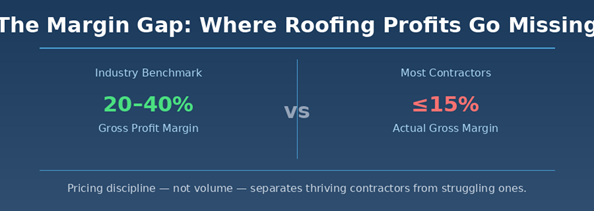
The industry benchmark for roofing is a gross profit margin of 20–40%. Most roofing contractors are operating at 15% or less. For painting, where material costs are lower, margins should be healthy — yet most painting companies consistently underperform because labor is underestimated and scope isn't controlled.
The contractors who consistently hit 8–12% net profit aren't doing more volume than their competitors. They have better pricing discipline. They know their numbers. And they train their sales staff — or themselves — accordingly.
This isn't complicated. But it is specific. You need a clear cost structure. You need a markup formula that actually protects your margin. You need a consistent quoting process that accounts for all the real costs of doing a job. And your sales team needs to understand why that number is what it is — not so they can defend it awkwardly, but so they can believe in it and hold the line when a customer pushes back.
This Is Where Most Business Owners Get Stuck
You didn't start a painting or roofing company because you love spreadsheets. You started it because you're good at the work, you know how to build a team, and you saw an opportunity. Pricing strategy and financial modeling probably weren't part of the plan.
That's not a character flaw — it's a gap. And gaps are fixable.
At Adamo Advisors, this is exactly the kind of work we do. We help home services business owners build the pricing frameworks, internal training, and financial discipline to stop leaving money on the table and start running a business that actually grows the way it should.
Whether it's working directly with you as the owner-operator, or building the structure and training to bring your sales team into alignment, we help you get a handle on the numbers that matter — and make sure the people quoting your jobs understand them too.
If your trucks are busy but your bank account doesn't show it, the pricing is the problem. Let's fix it.
Ready to stop guessing and start pricing with confidence?
Schedule a call with Adamo Advisors today.
Let's take a hard look at your numbers and build a pricing strategy that actually works for your business.